



Puzzling (Mis)adventures: Volume 13: Where is My Heart?, Back to Bed

Back to Bed
Although the term “surreal” tends to be used quite a bit when discussing video games, Surrealism – the art movement exemplified by Salvador Dali – doesn’t have as much representation, and I’ve always thought that to be a missed opportunity. There’s just something about the strange, often unsettling nature of Surrealist works that seems perfect for exploration through an interactive medium, and developer Bedtime Digital Games seeks to take advantage of that fact with their 3D puzzler Back to Bed. The unique Dali-esque design is overshadowed by a lack of variety and ambition across the entire game, but the art makes a good first impression and there is some puzzling fun at times.
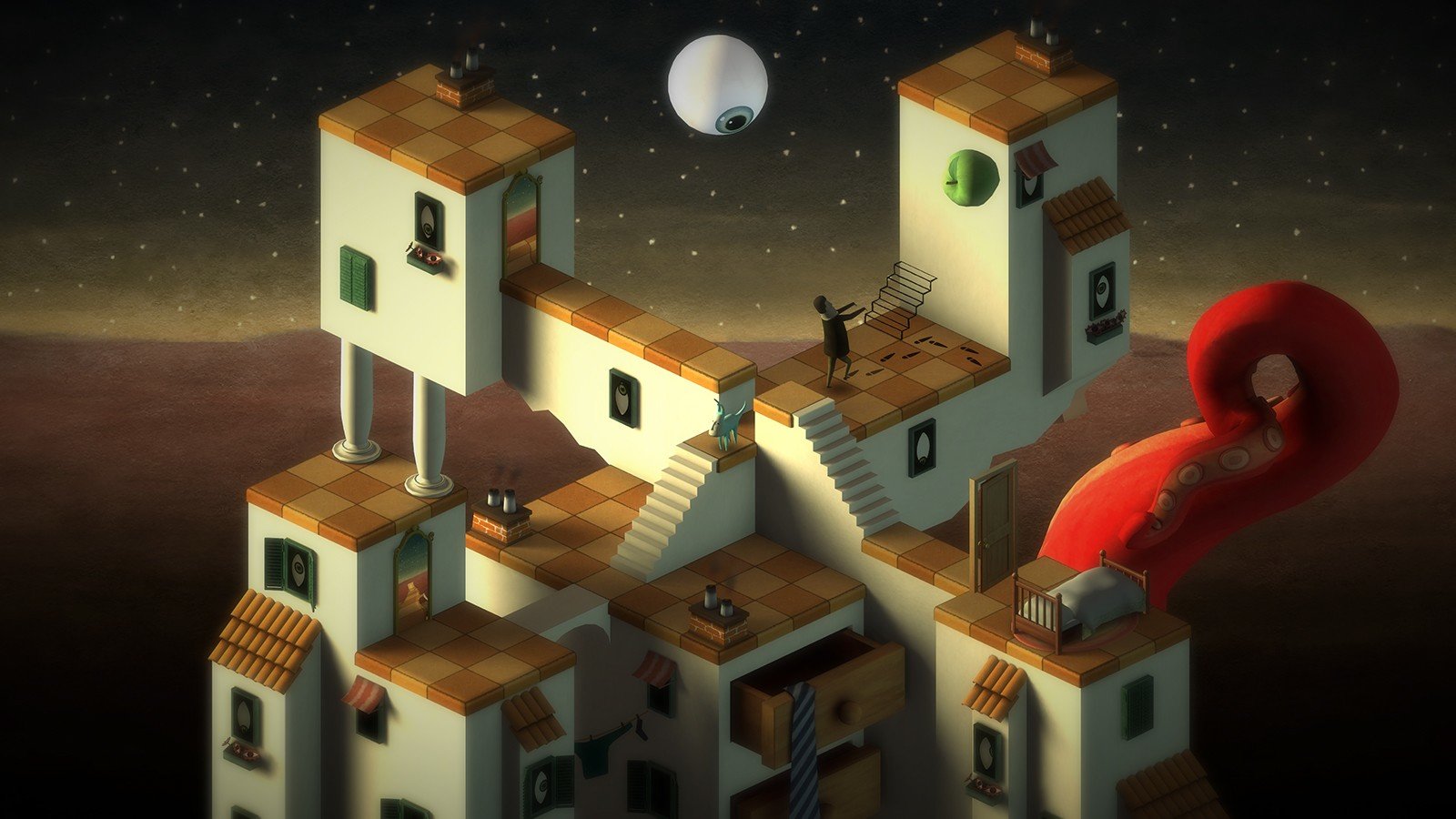
Only the most threadbare of narratives (a basic premise, really) ties the game’s thirty levels together, “told” through a few crisply-drawn, Art Deco-style animation sequences that appear between certain levels: Bob, the main character, has narcolepsy and suffers from severe bouts of sleepwalking. He often falls asleep at unfortunate moments, such as while at work in his high-rise office building. While unconscious, he takes a stroll across rooftops and other hazardous environments, his dreaming mind transforming ordinary places into strange and unsettling locales, populated by enemies like nightmarish dogs, trains that take the form of giant whales, and anthropomorphic alarm clocks that threaten to wake him up.
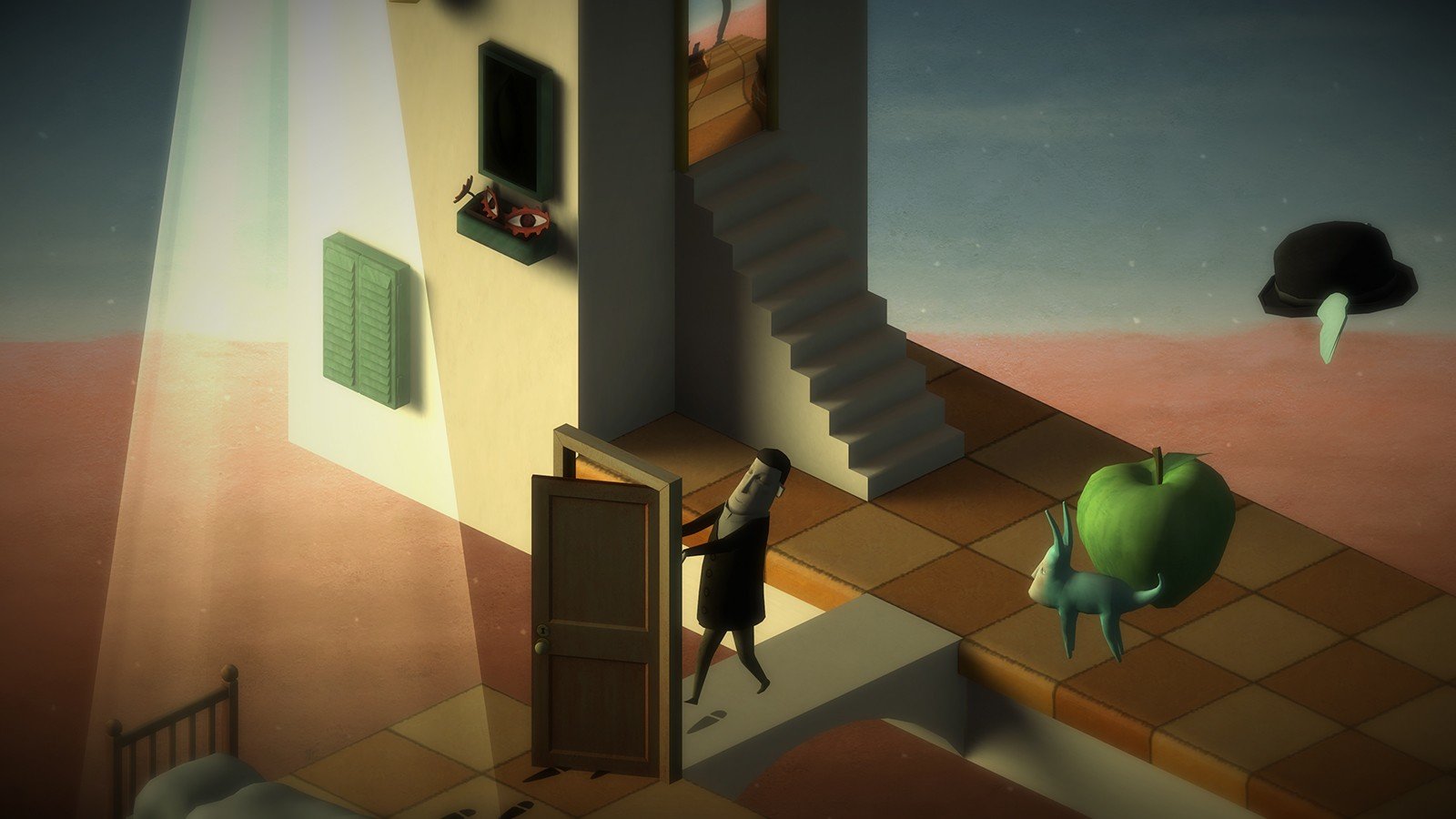
The player’s main task is to guide Bob, who ambles slowly through each level with arms outstretched, back to the safety of his bed, navigating the terrain and avoiding various hazards and enemies along the way. But there’s a catch: you can’t control him directly. Instead, you take control of Subob, a green dog-like manifestation of Bob’s subconscious mind, who serves as a dream-guide of sorts. The first few levels form a brief tutorial, introducing the concepts needed to master the challenges ahead, such as how to navigate Subob around, pick up and place objects, and how to lead Bob back to his bed, usually located in a spot that looks deceptively accessible from where our sleepy protagonist quite literally drops into the level. The maze-like environments are clearly inspired by the optical illusion-based works of M. C. Escher, and include things like stairs that lead to traversable walls (often containing an object that the player must retrieve), floors that seem to intersect with higher ground, and even portals that allow the player (and Bob) to go from one place to another in an instant.
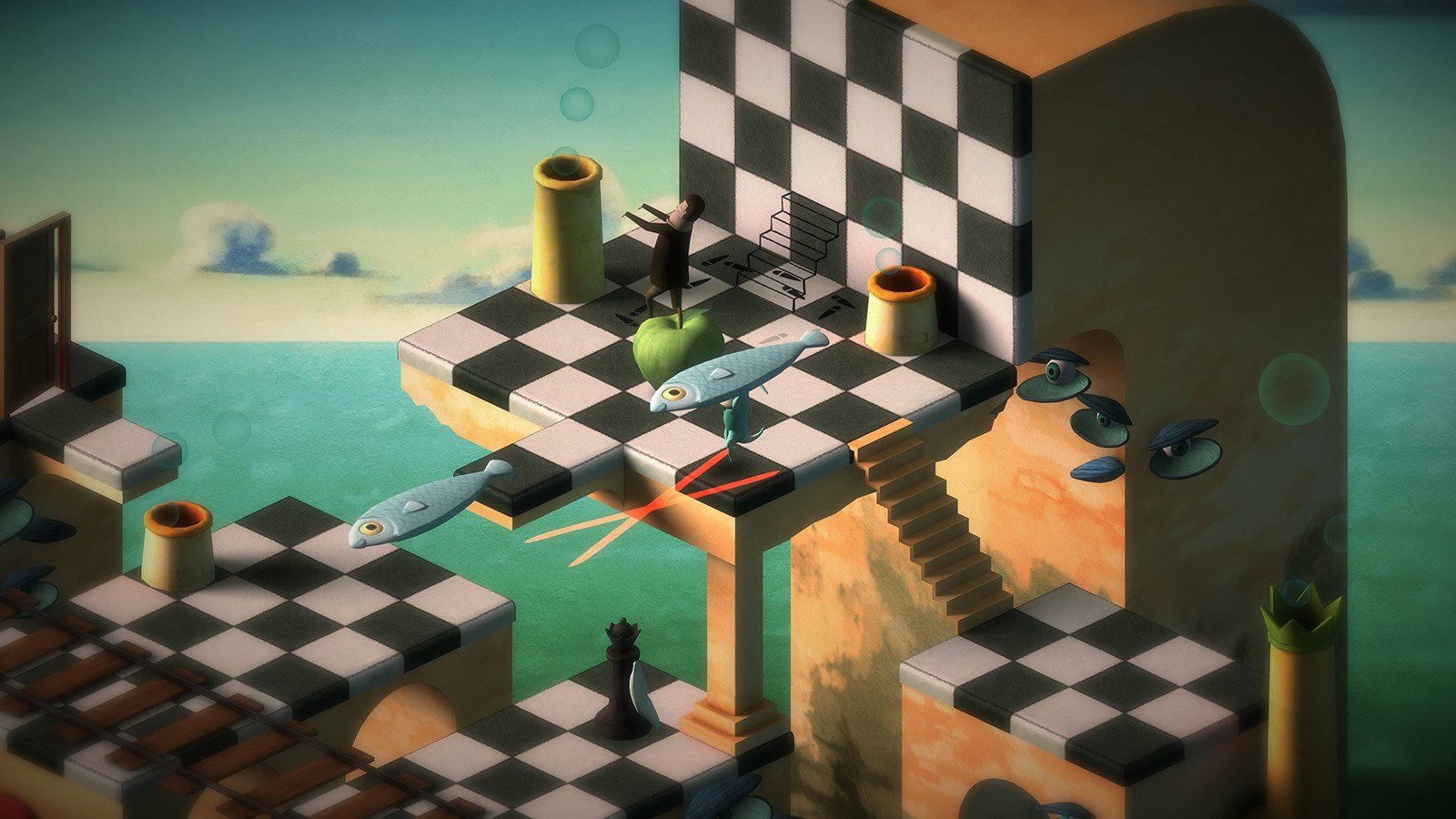
Much of the game’s challenge comes from having to analyse and solve each level in real time, modifying Bob’s course just in time to save him from falling into the void or encountering an enemy, using moveable obstacles scattered throughout the environment. These include giant green apples (a sly reference to artist René Magritte) and, in later levels, fish-shaped bridges that allow you access to areas that would otherwise be off-limits. Such objects must be used in conjunction with fixed obstacles scattered around each level, such as walls and chimneys that cause Bob to turn, and air vents that push Bob off course.
Bob himself also has a hand in making life difficult, because he can only make right turns after coming into contact with an obstacle. The effect of this limitation is that the most simplistic level often requires a circuitous solution. For example, one level begins with Bob only a short distance away from his bed, but facing away from it. In order to solve the level, you must deduce how to successfully turn Bob 180 degrees, filtering out misleading environmental clues and items that appear to be part of the solution, but ultimately have no purpose other than set decoration. As Bob walks forward, his expected path is displayed as a series of footsteps on the ground, which helps the player determine where Bob is headed, including any turns he might make along the way.
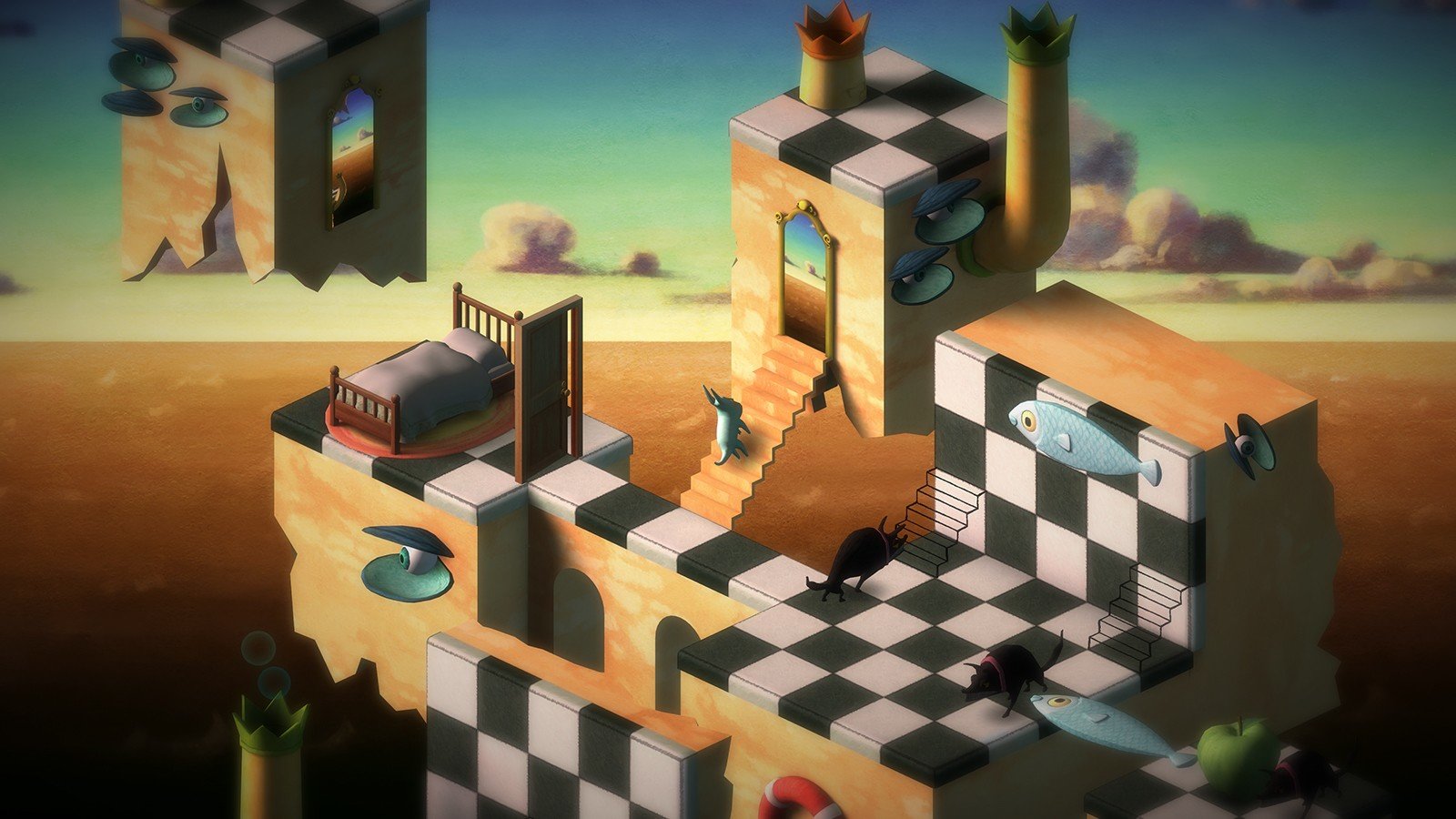
There is a pause function for when you need to take a break, but the camera, which displays each level from an isometric perspective, cannot be moved around while pausing, preventing players from “cheating” and inspecting the level without risking Bob’s safety (if such a thing could, in fact, be called cheating). Since timing is an important element when solving many of the puzzles, anyone who is particularly averse to timed sequences would also be advised to avoid Back to Bed. Most players, however, should be fine.
Bob met his “demise” far more times than I could count during my playthrough, but it’s worth noting that there are actually two different types of failure that you can encounter. Falling off a ledge only results in Bob returning back to the beginning of the level. Depending on the solution required for that puzzle, you may have to backtrack in order to guide Bob back to the point where he fell, but otherwise the level continues on. However, when Bob is woken up, such as when he encounters an enemy, the game immediately ends, bringing up a screen where you can choose to either restart the level or return to the main menu. While this difference might seem like an arbitrary (and occasionally frustrating) distinction, it does raise the stakes for certain actions, such as when Bob crosses through an area filled with enemies.
Despite Bob’s ambling pace, there are times when the game becomes a tense scramble to ensure that all the objects are placed properly, especially when you only have one apple and have to follow Bob through a tight, obstacle-laden area to keep him on track. Even so, I hate to say that I eventually succumbed to boredom. The game is split into two fifteen-level sections, the first half consisting of a cityscape theme and the back half featuring a nautical motif, with new obstacles (such as the air vents) added throughout. However, despite the increasing complexity of the levels, there are only two that ever gave me any real challenge at all. In fact, the entire first half on city rooftops is so breezy that it feels like an extended tutorial, and the difficulty really doesn’t raise significantly even after that point. By the end, the fun had worn off and I was just going through the motions in order to finish the game.
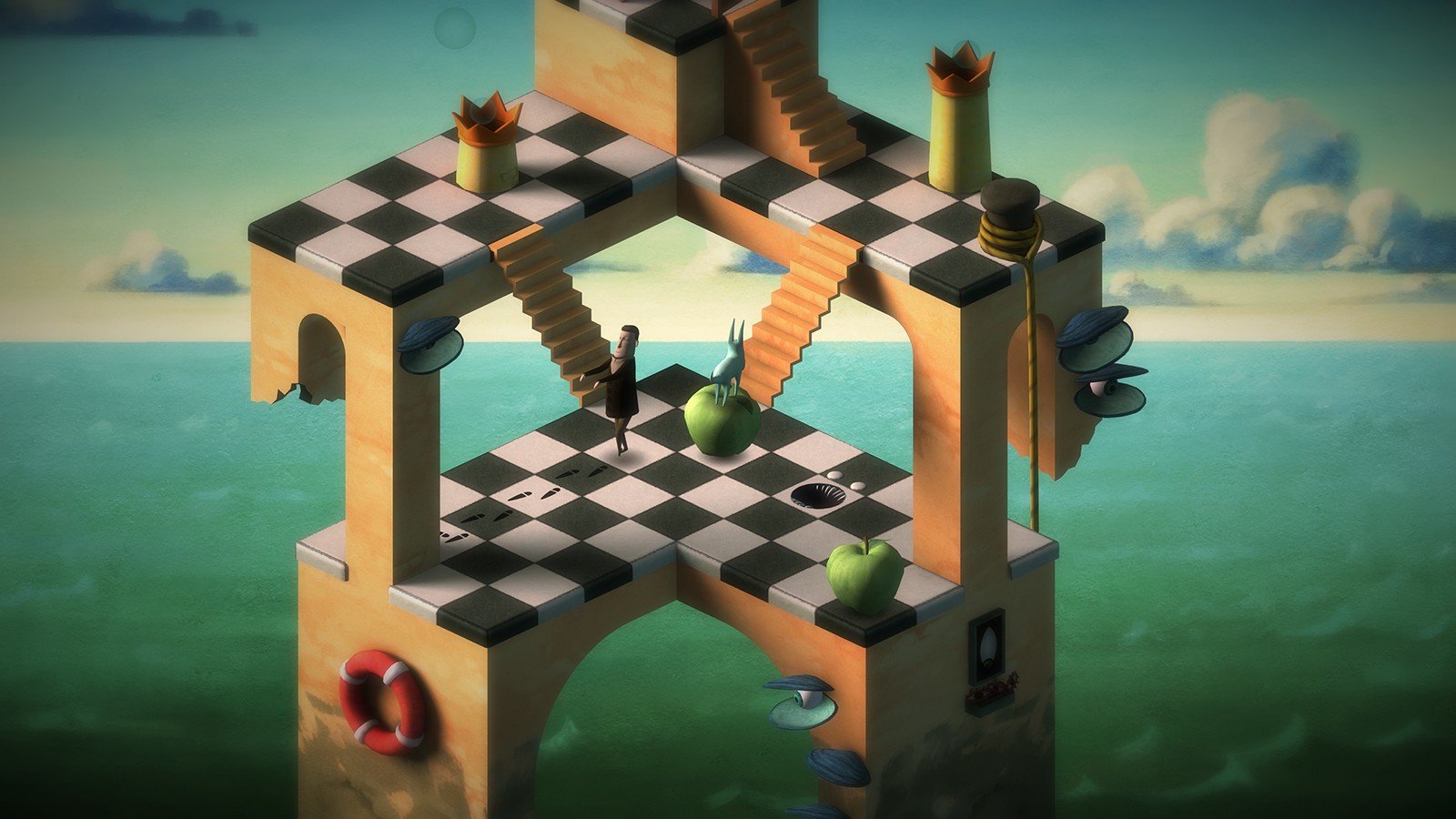
There are glimpses of what could have been, though. The final level toys with a mechanic using an optical illusion based on the camera’s isometric perspective. It isn’t really complicated at all, but it is one of the few puzzles that had me scratching my head for a solution, and actually is quite satisfying to solve, mainly because it utilizes the Escherian aspects of the level design to a greater extent, and in a far cleverer way, than in all the previous levels. Based on this experience, it is clear that Back to Bed could have been a much more varied, innovative game, and I have to wonder why more of these kinds of puzzles were not included. Whatever the reason, the presence of just the one reinforces how incomplete the gameplay feels when taken as a whole.
My initial playthrough lasted around 2½ hours, after which there was an opportunity to experience “nightmare mode.” Anyone expecting new levels, or even the same levels with more obstacles and traps (something that would have actually been worth the time to check out) will be disappointed. Instead, nightmare mode consists of the same levels, but this time the door that Bob’s bed always sits behind is locked, so you must retrieve a key placed somewhere in the level. Obviously, this allows for a longer experience, but I just don’t see it being something most players will be interested in, other than perhaps hardcore completists and those who really want to squeeze all the puzzling they can out of the game. Honestly, for whatever amount of trouble the developers went to in order to include this mode, I would much rather have seen a more varied core set of levels.
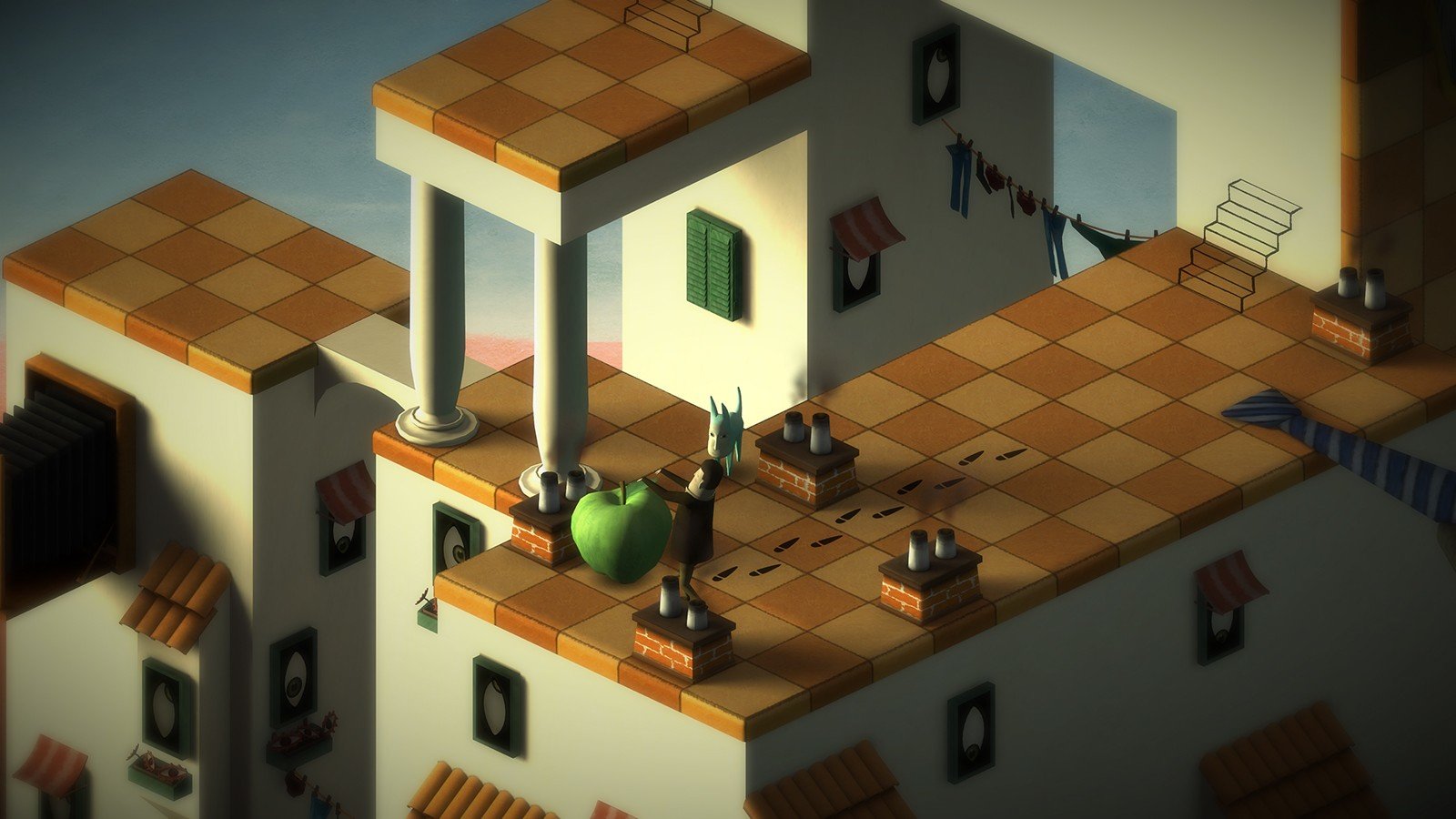
You have a choice of controlling the game using a gamepad or mouse. If using the mouse, holding the left button down and moving the mouse in a given direction allows you to move Subob around, and right-clicking when adjacent to (and pointing the cursor at) an object allows Subob to pick it up and set it down again. Both controller options are viable, although they can also be frustrating during sequences that require quick timing. The ground is shaded in alternating light and dark squares, much like a checkerboard, and each square corresponds to valid locations for object placement, lighting up when carrying an object over it to show that it may be placed there. More than a few times, however, I picked up an object and ran to place it in front of Bob before he fell into the void, only to have the highlighted square change abruptly. This resulted in placing the object down on the square next to the intended one and watching helplessly as Bob trudged right on toward his demise, with no time to fix the mistake. The issue does not seem to be a bug, but instead a symptom of the picky placement grid tolerance. Fortunately, this issue doesn’t raise its head too often.
Much of my initial interest in Back to Bed came from the prospect of seeing how the classic themes of Surrealism, like melting clocks and barren landscapes filled with strange creatures, might translate to an interactive medium, and in many ways the artists have succeeded in bringing this distinct vision to video game form. Each of the game’s thirty levels feels as though it could have been painted by Dali himself, with earth tones like pale orange, brown, and tan accompanying more vivid hues like greens and blues. The cutscenes that play between certain levels have an ominous tone to them, owing mostly to the music. They are interesting for their clean, hand-drawn illustrations, and they are the sole attempt to give the game a narrative, but they lack the depth or the time needed to do so. In any case, they work well as transition animations between the two sets of levels, and as beginning and ending cutscenes.
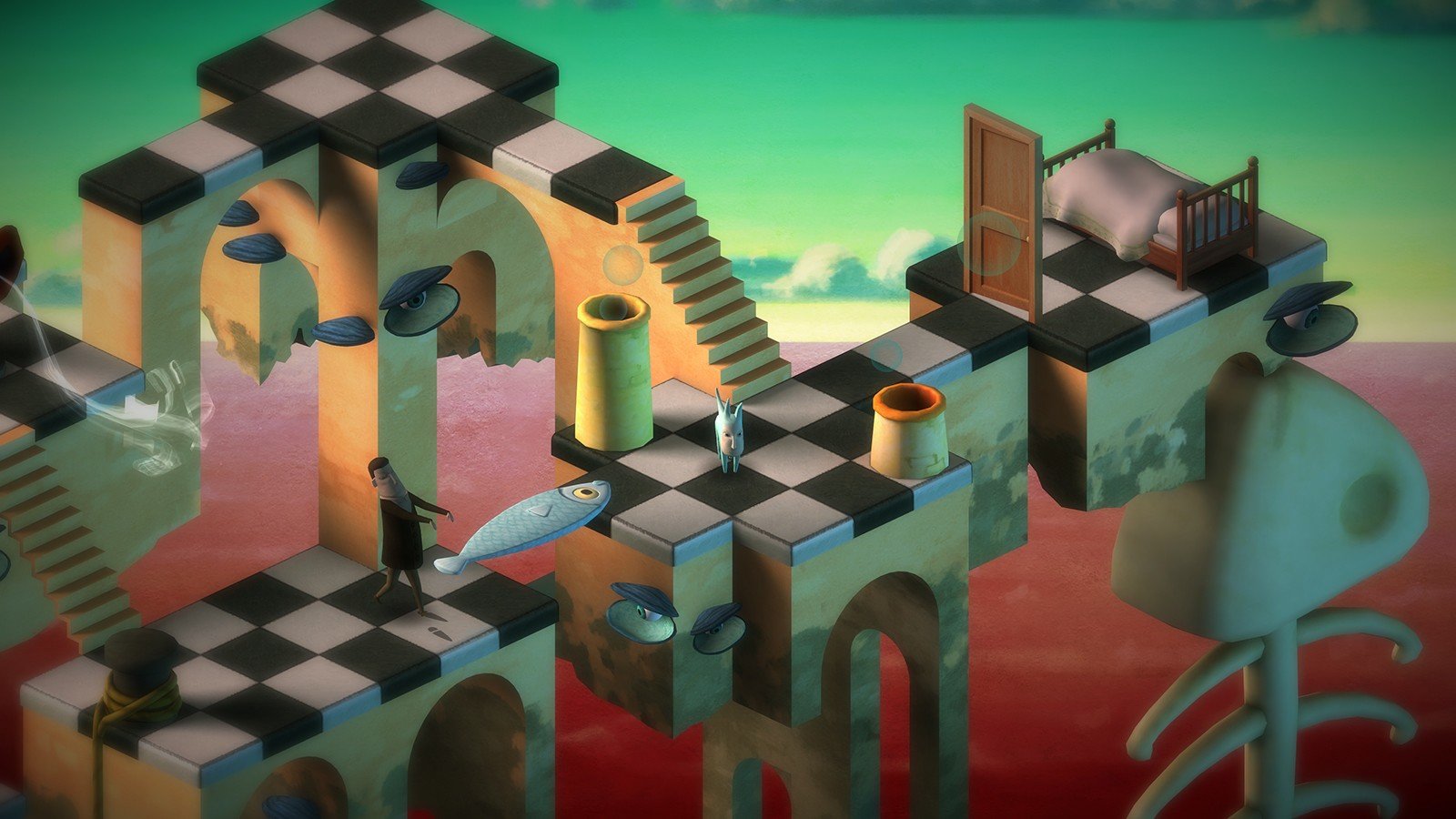
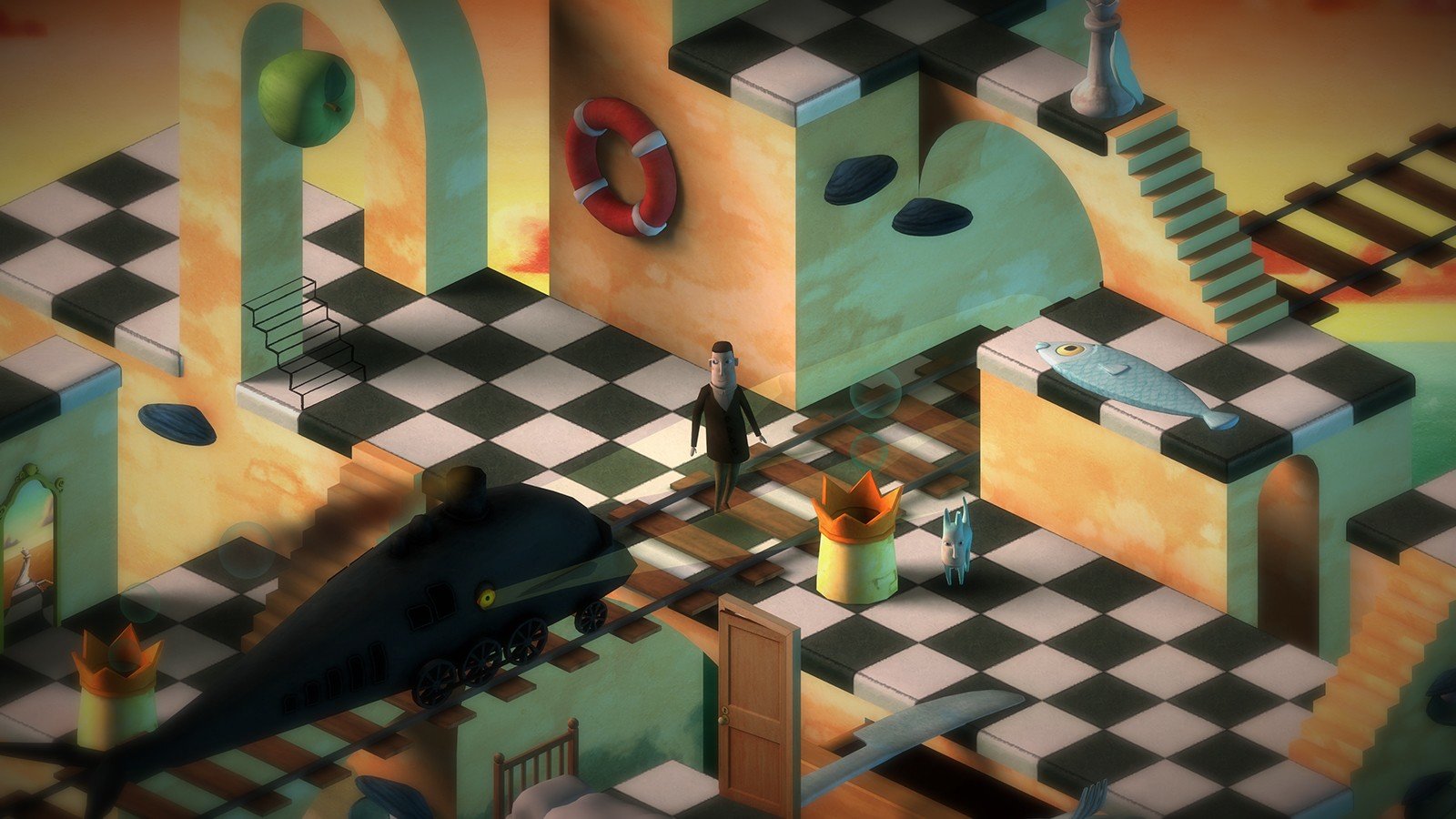
The cityscape levels and harbor levels are largely similar. The former has chimneys and walls atop tall buildings that crumble away into the void, and the arrival of the harbor motif causes the scenery to change accordingly. It’s mainly superficial, however: in place of chimneys there are smokestacks; instead of windows on the sides of buildings, clamshells and lifesaver rings dot the terrain. Plenty of strange sights can be found across both themes, including creatures such as winged chess pieces, bowler hats that squawk as they fly through the air, and clocks that run backwards. Disembodied eyes peer from behind window shutters and from inside clamshells, the latter reminiscent of pearls. Fanged dogs and anthropomorphic alarm clocks roam many of the levels, and other creatures are just as bizarre, such as trains that appear as giant whales, and traps in the floor that take the form of hungry, long-toothed maws.
At first, the sheer pleasure of seeing such unusual images is a treat. You are faced with a veritable avalanche of Surrealist tropes (yes, animated melting clocks do make an appearance, and yes, they are hypnotic) that make references to several renowned works and their artists, and multiple times it felt as though I were truly exploring a moving Dali painting. Yet after this strong initial impression, I eventually became dissatisfied with the graphics. Only a few levels in, I was struck by how similar everything looked and felt, and it only got more repetitive from there. It’s not that the art style itself becomes stale; it’s that there isn’t a whole lot of variety to give it substance. The same environmental assets are reused over and over again with no change in color or appearance. Even when the game switches from the cityscape to the nautical theme, there’s simply not much difference between the two, aside from simple cosmetic changes, echoing the same problem with the gameplay mechanics.
Sound effects comprise one area where the game performs fairly well. Subob makes a skittering noise as he walks, and Bob’s footsteps can be heard making a light plodding sound. Other effects, like Bob’s bedroom door and the various creatures inhabiting each level are nicely atmospheric. Bob snores throughout the game, which can be a bit grating, but it is quiet enough that it doesn’t become too bothersome. An auditory highlight comes in the form of the disembodied, distorted male voice that narrates the tutorial and continues to chime in periodically to comment on things happening onscreen. His nonsensical musings are quite comical (“The apple is a hat,” he says at one point, while Subob carries an apple over his head), and they constitute one of the few things that I can praise without qualifications.
The music is dreamy and downtempo, but like almost every other part of Back to Bed, it feels woefully underdeveloped. There are only a few tracks, and it sounds as though only one of those is used as background music, though the tunes are so similar to each other that I was never certain if that was actually the case. There is definitely a different score for the cutscenes, which is appreciated, but it’s baffling that with so few tracks, the developers didn’t make all the music available as background music for the levels.
The thing that most stands out about my experience with Back to Bed is its lack of ambition. There are so many times that the game could have done something more compelling, whether through gameplay, art style, or music, but instead opts to go only halfway, shooting below a target that wasn’t really all that high to begin with. There is some fun to be had with the puzzling gameplay, but it quickly succumbs to the same lack of initiative and variety that affects the rest of the game, leaving you to go through the motions of solving numerous iterations of the same puzzle. As excited as I was to see a Surrealist interpretation alongside an equally-promising Escher-inspired level design, this game let me down. It’s not a “bad” game as much as it is an incredibly (and at times, bafflingly) mediocre production that never aspires to be more, even when there are obvious opportunities to do so. There are better puzzle games out there, and at least for now, Salvador Dali is still the undisputed master of Surrealism.
Latest Gaming Articles
All Articles