



Puzzling (Mis)adventures: Volume 7 – Stick It to the Man, Tiny Thief

Tiny Thief
Pascal Tekaia
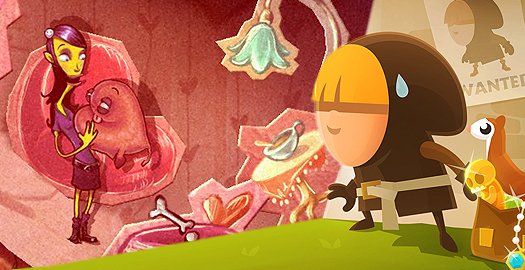
Many are the tales of happy-go-lucky Robin Hood and his band of merry men, outlaws with hearts of gold and wits as keen as any blade. These tales of medieval pageantry; corrupt officials; bawdy, downright silly humor; damsels in distress; and a carefree way of dodging danger and eluding capture have been around for centuries for a reason. Who hasn’t at some point dreamed of robbing the rich to give to the poor, or outsmarting a dim-witted bully by stealing his most prized possession right out from under his nose? Such is the world of 5 Ants’ point-and-click stealth puzzler, Tiny Thief.
Tiny Thief has you taking on the role of the eponymous outlaw, a rogue-ish scamp who hides in crates, barrels, and behind bushes to avoid being caught, in between standing up for weak and helpless villagers who have been wronged by the greedy sheriff and his men. This is not just limited to pilfering treasure; wherever there is a way to rain on the sheriff’s parade, Tiny Thief will find a way, whether it’s making off with the sheriff’s specially-commissioned birthday cake or swiping the wig off of his head in public.
This game combines elements of point-and-click adventures and stealth-based gameplay with a heavy dose of trial-and-error puzzle solving to create a silly, humorous, and colorful world of tongue-in-cheek slapstick and wicked potty humor. Each of the game’s five chapters is divided into five scenes, generally composed of one or a small handful of screens for Tiny Thief to navigate through. As he progresses, he must stay out of sight, for guards, pirates, and other adversaries are on the lookout. To help him get around them, you’ll have to use the environment to hide, distract or even dispatch his pursuers in devious ways.
Exploring a room’s secrets is required, and random clicking is encouraged, as interactive objects aren’t automatically marked in any way. At times, Tiny Thief will have to be in direct proximity to an object to interact with it; other times a simple click of the mouse will cause it to open, move, dislodge, or any number of other actions – there is really no rhyme or reason to it. There is no penalty for incorrect clicks though, so going wild with your clicker finger is a perfectly acceptable strategy.
Occasionally, Tiny Thief will come across an item that he will pick up and keep instead of activating on the spot. This indicates he’ll need to use the item somewhere else within the scene to reach a ledge, get another object, cause a distraction, or just in general make something vital happen. Sometimes these items even need to be used in tandem with other items in your inventory before their purpose is revealed; however, as the player you have no control over inventory. Items go into Tiny Thief’s inventory and are used up automatically when you click on the right spot to use them. Objects that combine with others to create an all-new item do so automatically when all the required ingredients have been collected. As such, the inventory in the bottom corner of the screen really exists for no other purpose than to provide a visual representation of the items you have with you at any given time.
Each of the game’s 25 main campaign scenes has three separate objectives to achieve. The first is the main objective; this is the item or treasure (or sometimes person) that is the main focus of the scene, without which the story cannot move forward. This can range from a treasure map to a kidnapped princess, or may be a place you must get to, like sneaking aboard a pirate ship before it departs for a distant treasure island or becoming a ghost and entering the underworld. Once the main objective has been achieved, the level can be exited at any time.
The second and third bonus objectives provide extra stars (collectibles for completionists) and achievements for finding them. Each stage has a certain number of hidden bonus treasures that can be found, which do not play any role in the story, but are collected in a main menu treasure trove for thieves who really want to live up to their profession. Tiny Thief’s pet ferret also stows away somewhere in each scene, and finding him before completing the level nets another star. Some of these bonuses are hidden in plain sight, while others require manipulating objects or operating machinery within the level to reveal them.
Tiny Thief is a light-hearted take on the medieval time period in which it’s set. Oppression of the poor, siege warfare and sacking of castles, even cannibalism and reanimation of the dead are all given a comedic treatment through silly animation and sound effects. In terms of visuals, think cardboard cutout visuals along the lines of South Park, if perhaps a bit more colorful. There is no dialog or narration, but characters communicate via gestures and articulated grunts. This in and of itself made me giggle more than once, as the art style gave the designers much license to be goofy. For example, at the end of each scene, Tiny Thief performs a little victory dance upon reaching the exit, anything from Moonwalking to a Russian Cossack dance.
The visual gags aren’t limited to victory dances; there are little Easter eggs strewn throughout the game as jokes. Clicking a resting bird on a rooftop in one early scene causes him to soil the helmet of the poor soldier haplessly standing directly underneath him. In another area, clicking on a witch’s broomstick as she flies in the background causes her to lose control, eventually spiraling out of control and crashing into the foreground. Many interactions are slapstick in nature and designed to make you smile, like setting free a caged circus bear and, after a beat of speechless recognition, watching him chase after the clown that was teasing him just moments ago, or pulling the curtain back on a showering pirate time and time again. These little touches bring a lot of charm to the title, and really highlight its accessibility, whether you’re a fan of puzzlers or not.
Speaking of which, the question of where on the adventure game spectrum Tiny Thief falls – whether it’s even an adventure at all – is up for debate. While the (token) inventory system and point-and-click interface are familiar staples of the genre, the game doesn’t offer much in the way of environment exploration, character interaction, or even, perhaps most importantly, a plot threading throughout the individual chapters, tying all the pieces into a story with a beginning, middle, and end. Yes, there are occasionally broad, sweeping generalizations that cover an episode’s “plot”, such as “The evil sheriff is mistreating the villagers and needs to be run out of town.” But these story points exist merely as objectives for the individual scenes, not elements of an overarching narrative. Environmental exploration is limited to “click on stuff to see what happens”, while the interaction between Tiny Thief and other characters occurs rarely, and even then only in comic-book-style panels between playable scenes.
Nevertheless, Tiny Thief is an extremely pleasant experience, if somewhat on the short side. In just under four hours I was able to complete the core game, and even had time to go back and replay some scenes to find items I’d missed earlier. The challenge of finding the bonus items in each stage ramps up quite a bit in later levels, providing some replayability for those who want to find them all. Peeking at an overly detailed hint book (with illustrations!) showing exactly what to do and where to click to find each and every secret in each level will certainly help you find everything the game has to offer, but doing so will take away any true sense of accomplishment. All in all, this is easily a game that will appeal to a wide audience for its blend of humor, puzzles, and likeable characters and setting, and regardless of its genre, it’s well worth a look for any adventure gamer.
Latest Gaming Articles
All Articles